Louis Soutter: Finger painting 1937 - 1942
Paris, France
Tuesday - Saturday, 10 am - 7 pm
Vernissage
on Saturday, November 14, 5 pm to 7 pm
The exhibition is accompanied by a catalog with texts by Julie Borgeaud and Peter Sloterdijk.
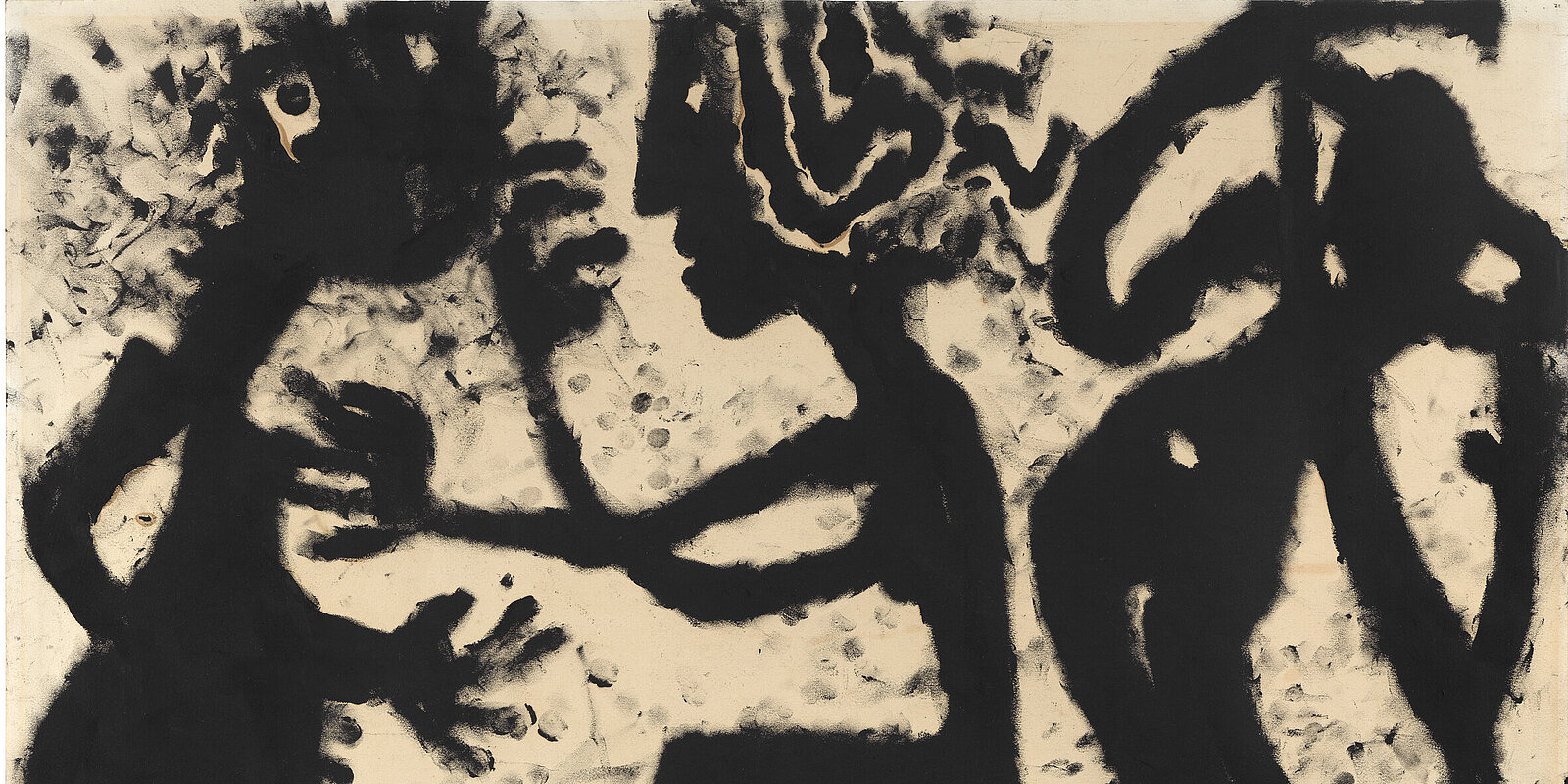
Galerie Karsten Greve Paris is delighted to present a new exhibition dedicated to Louis Soutter and his finger paintings. Between 1937 and 1942, during the final five years of his life, the Swiss artist developed a remarkably intense visual language, exploring an instinctive approach in which gesture and the human figure occupy a central place. With his fingers dipped in ink, he traced enigmatic and highly expressive silhouettes directly onto the paper.
Born in Morges, Switzerland, in 1871, Soutter was a cultivated man whose education encompassed visual arts, architecture and music. He studied the violin in Brussels under Eugène Ysaÿe before moving to the United States. Settling in Colorado with his American wife, he taught drawing and led the Department of Fine Arts at Colorado College. His marriage ended in divorce in 1903. Upon returning to Switzerland, he entered a prolonged period of personal and financial difficulties, marked by isolation and declining health. In 1923, at the age of 52, his family had him admitted to the hospice in Ballaigues. There, he continued to create until his death in 1942.
This secluded existence coincided with an extraordinary artistic output. Soutter continued to draw, experiment and constantly transform his visual language. From 1937 onwards, he developed a new technique, applying the medium directly on the paper with his fingers. Through this tactile approach, Soutter embraced a freer, more intuitive mode of expression. Elongated silhouettes emerged, formed by nervous lines, unfolding within spaces where black and white engage in a sustained dialogue, occasionally punctuated by vivid touches of colour. These characters radiate a powerful vitality: some seem to dance, while others gather or interact in a variety of dynamic configurations. Beneath the apparent spontaneity of the gesture lies a remarkable mastery of rhythm and composition.
Soutter’s imaginative world is shaped by a rich array of cultural and symbolic references. Music, biblical narratives, mythology and ritual figures permeate his oeuvre, appearing in both his titles and imagery. Works such as Le Jésu, Abel, Prêtresses, druides evoke primordial forms as well as representations drawn from ancient tales. Rather than simply illustrating these references, Soutter freely reinterprets them.
Louis Soutter occupies a singular place in the history of modern art. His oeuvre, which eludes any definitive classification, has had a profound influence on artists such as Jean Dubuffet and contributed to the broader discourse surrounding Art Brut. His unsettling compositions bear witness to an exceptional creative personality and to the radical nature of an artistic quest that retains its full evocative power today.
During his lifetime, Louis Soutter (1871–1942) received the support of several personalities who helped bring his oeuvre to wider attention, including Jean Giono, the Vallotton brothers, who exhibited his works in their gallery in Lausanne, and his cousin, the architect Le Corbusier, who devoted an article to him in the magazine Minotaure in 1936. In 1961, the Musée cantonal des Beaux-Arts in Lausanne held his first retrospective, then the Fondation Le Corbusier brought an important part of his drawings to light. Galerie Karsten Greve contributed to the recognition of Louis Soutter in Europe and throughout the world, thanks to a major exhibition in 1998 in Cologne, then in the same city in 2021, in St.Moritz in 2011 and 2026 as well as in Paris in 2020 and 2024. Soutter’s works are presented in numerous international exhibitions and are part of major private and public collections, including those of the Kunstmuseum Basel, the Kunsthaus Zürich, the Centre Georges Pompidou in Paris and the Museum of Modern Art in New York.
