Loïc Le Groumellec: Écritures, mégalithes et Cupules III
Galerie Karsten Greve, Paris
Tuesday - Saturday, 10 am - 7 pm
Opening
Saturday, January 17, 2026, 5 pm - 8 pm
in presence of the artist
Galerie Karsten Greve is pleased to present Ecritures, Megalithses et Cupules III, a solo exhibition by Loïc Le Groumellec. This exhibition marks the third chapter of a journey that began in St. Moritz then Cologne. The new display brings together recent works that encapsulate several decades of research around a single theme, bringing painting to an extreme state of reduction. For the first time, Le Groumellec introduces a new symbol into his vocabulary: the cupule.
Since the 1980s, Loïc Le Groumellec has been developing a visual language based on the intentional simplification of forms. Like Giorgio Morandi, for whom objects were primarily a means to delve deeper into the nature of painting itself, Le Groumellec uses symbols like writings, megaliths, and cupules not to illustrate archaeological subjects, but to explore the fundamental force of painting when it nears its simplest and most elemental state.
A significant portion of his work explores a repertoire of elemental signs: silhouettes of standing stones, shapes akin to ideograms, engraved curves, and almost calligraphic forms. These motifs are treated as an archaic grammar. Repetition, along with subtle variation, creates a visual space where the question is less about representation, and more about the effect these reduced forms have on the viewer’s perception.
Le Groumellec’s early discoveries in the archives of Rennes, and later at Neolithic sites in Morbihan, led him to observe prehistoric stone engravings. These carvings suggest the existence of a language that predates the written word. In his gouache series, he transposes this presence into signs that reappear like musical motifs, repeating and resonating across the canvas.
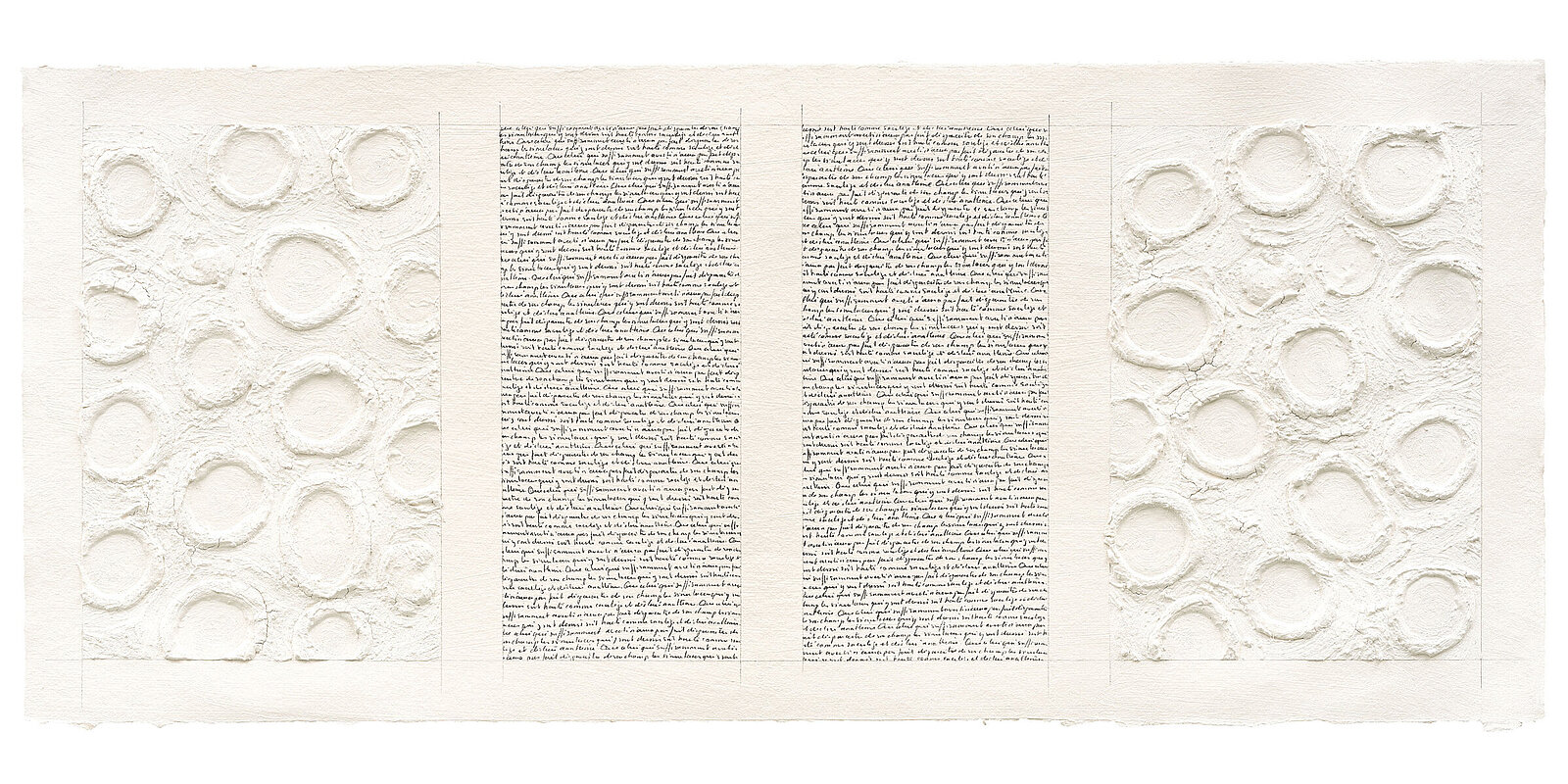
A more recent turn in his work came after visits to the Gavrinis cairn, where he encountered the cupules, small, circular cavities carved into stone. The precise purpose of these marks remains a mystery, but they are believed to be a form of early writing or a part of rituals, possibly linked to the grinding of pigments or sacred substances. Introduced into his work from 2023 onwards, these hollow forms become anchor points from which the composition is organized, as if a void charged with energy draws and structures the gaze.
Alongside these cupules and menhirs, a delicate, handwritten script structures his triptychs. A phrase taken from the capitularies of Charlemagne, in which the emperor sought to erase traces of pagan cults, including megalithic monuments. The artist focuses on three key words: simulacrum, sacrilege and anathema to reflect on how images can be perceived, feared, or condemned.
For Le Groumellec, these motifs are not mere representations, they are vectors of meaning. The minimalist nature of these signs directs attention to the surface of the canvas, the subtle vibration of shapes. Through an extreme economy of means and repetitive patterns, he transforms symbols into pure signs. This approach, which he ties to the legacies of Minimalism and monochrome painting, stands in contrast to today’s overwhelming and often spectacular flood of images. Le Groumellec asserts that painting can regain its spiritual dimension when it approaches silence; the same profound silence surrounding the ancient stones of his native Brittany.
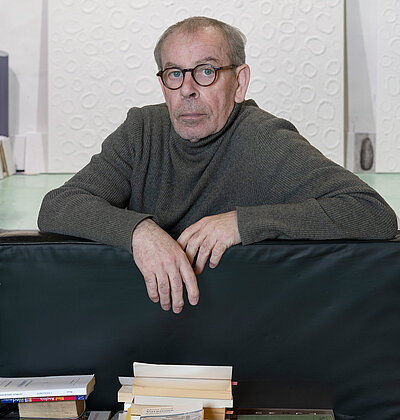
Loïc Le Groumellec was born in Vannes, Brittany, in 1957. He graduated from the École des Beaux-Arts in Rennes in 1980. In 1983, the Yvon Lambert gallery in Paris held his first solo exhibition. His works are part of prestigious private collections and have been included in exhibitions at institutions such as the CAPC in Bordeaux, the Musée des Beaux-Arts in Rennes, and the National Conservatory of Music in Paris. His art has been presented at major international venues, including the Nouveau Musée National of Monaco, the French Institute in Cologne, the Fondation de l'Hermitage in Switzerland, the Musée d'Art Contemporain in Montreal, and the Fundación Joan Miró in Barcelona. Le Groumellec has also designed theatrical sets, including for the Basel Theatre and the Opéra Garnier in Paris, and has contributed to numerous illustrated books. Galerie Karsten Greve has represented his work since 1989. Loïc Le Groumellec lives and works in Paris.