Cy Twombly: Sperlonga 1959
Galerie Karsten Greve Paris
Tuesday - Samstag 10 – 19 Uhr
Opening
Saturday, September 12, 2026, 5 pm - 8 pm
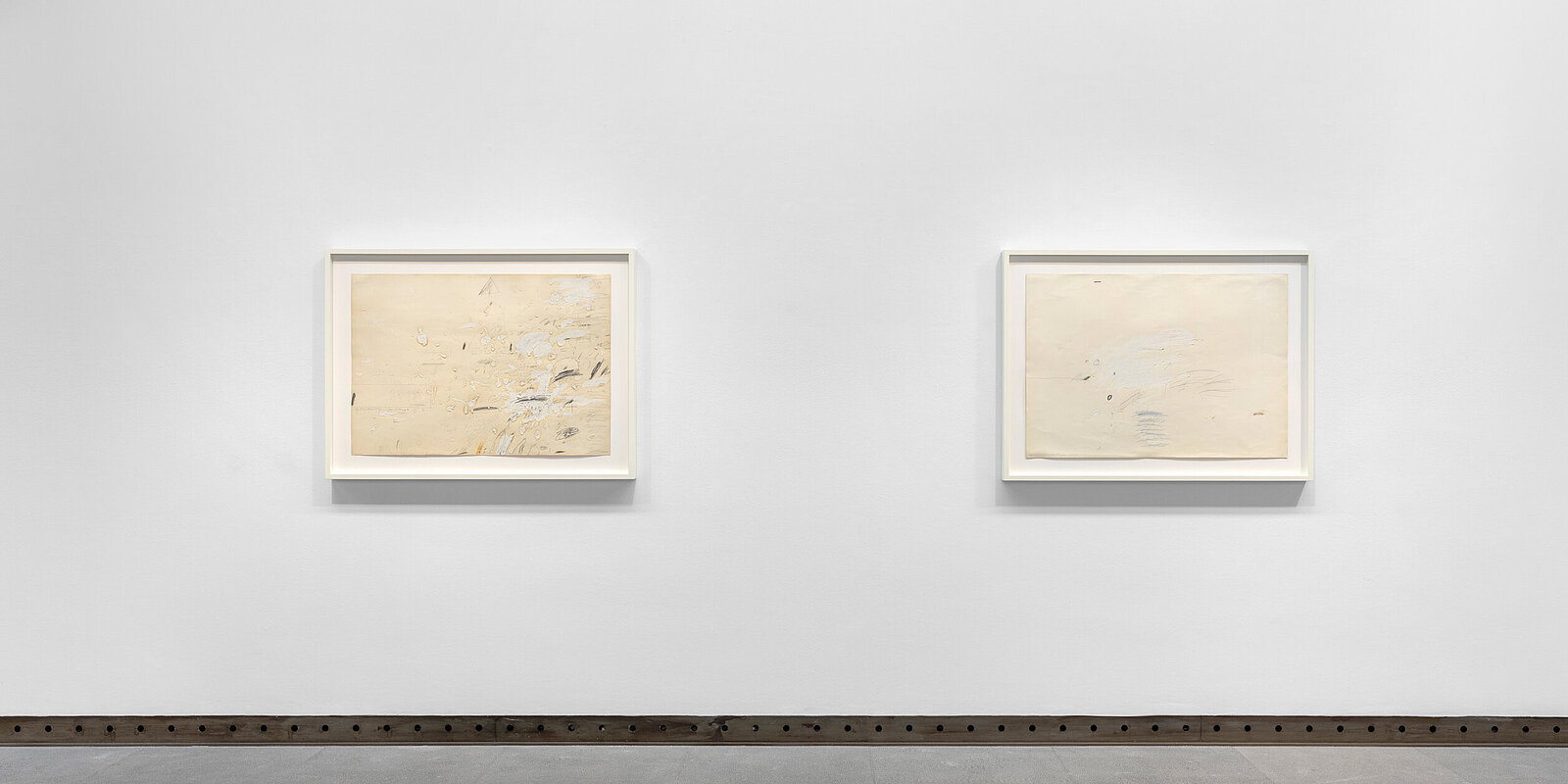
Galerie Karsten Greve presents an exhibition dedicated to one of the most decisive bodies of work in Cy Twombly's oeuvre: the Sperlonga Drawings, created in 1959. Bringing together a rare group of works on paper, the exhibition revisits the summer of 1959, when the artist, recently settled in Italy, stayed in the village of Sperlonga on the coast of Lazio. During this pivotal period, Twombly produced around thirty works that marked a major turning point in his artistic practice.
Nestled between Rome and Naples, Sperlonga is an emblematic place that held a profound fascination for Twombly. The artist was especially captivated by its Mediterranean light, describing the sea as "white three-quarters of the time." This luminous whiteness of the dazzling sun and the lime-washed houses permeates his works. Added to this experience was the nearby presence of the Roman Emperor Tiberius's villa, where the discovery in 1957 of a group of first-century sculptures inspired by episodes from the Odyssey brought renewed attention to the site's history. These sculptures, together with the surviving frescoes and mosaics, hold the memory of the ancient tales that nourish Twombly's imagination. Antiquity and its myths thus take tangible form at Sperlonga, just a few steps away from him.
The Sperlonga Drawings introduce a new conception of pictorial space into Cy Twombly's work. The horizon is never explicitly depicted, yet it is constantly suggested; a few graphic interventions, passages of paint, or broad expanses of untouched paper are enough to evoke the brilliance of sunlight on water and the vastness of the landscape. Lines, numbers, circles, and other almost cartographic signs are arranged within a largely open field, where emptiness plays as active a role as the artist's gestures. Twombly experiments with material, applying paint in thick touches or delicate impasto.
"The resultant drawings seem to open up a new, specifically landscape-like space in Twombly's work," observed art historian Kirk Varnedoe on the occasion of the artist's first retrospective at MoMA in 1994.
The understanding of landscape and its translation into images are fundamental aspects of Twombly's practice. Reflecting on this, he stated: "Probably even more than the architecture, I'd be drawn to landscape. That's my first love, landscape (…) The land affects people naturally, that's part of the characteristics, for me, of a people, in a sense." With Sperlonga, landscape becomes an experience of painting, a way of sensing space, its forms, its history, and its poetry. These works occupy a singular place within Twombly's oeuvre, already containing the explorations he would develop over the following decades.
Edwin Parker Twombly Jr., known as Cy Twombly, was born in 1928 in Lexington, Virginia. He studied at Washington and Lee University before attending Black Mountain College. In 1952, he received a grant that enabled him to travel throughout Europe and North Africa. Twombly settled in Rome in 1957 and remained based in Italy for the rest of his life, while continuing to travel extensively. It was in Rome that Galleria La Tartaruga presented his first exhibition there in 1958. He was invited to the Venice Biennale for the first time in 1964 and returned in 2001 to present his celebrated narrative cycle on the Battle of Lepanto, for which he received the Golden Lion. The series is now housed at the Museum Brandhorst in Munich. Cy Twombly's work has been exhibited in many of the world's leading museums and institutions, including MoMA, Tate Modern, and the Centre Pompidou, and is represented in major public and private collections. In 2010, he was appointed Chevalier of the Légion d'Honneur. Cy Twombly died in Rome in 2011. He was among the first artists presented by Karsten Greve, who devoted a first exhibition to his work as early as 1971.
![[Translate to Deutsch:]](/fileadmin/_processed_/a/7/csm_Galerie_Karsten_Greve-Cy_Twombly-stage_d0a227c07a.jpg "[Translate to Deutsch:]")